Sub-heading

A blog for everything bookish

Sunday, 29 June 2014

A Writer's Diary: Being Extracts from the Diary of Virginia Woolf


I’ve been a little obsessed with Virginia Woolf recently. Something happened after reading Olivia Laing’s excellent ‘To the River’ and since then I’ve found myself wanting to know more about this woman, this writer, who seems to be remembered more for walking into the River Ouse with her pockets weighted with stones than for her groundbreaking fiction. I’ve also been pretty obsessed with memoirs and personal stories, so Virginia Woolf’s diaries seemed a perfect read to me. It was also helpful that the wonderful Persephone Books include her diaries, as edited by her husband Leonard Woolf, in their catalogue so not only was I going to read insights from the mind of a great writer, I also got to lend my (small) support to the independent publishing industry. Oh, how virtuous am I?

Virginia Woolf’s diaries run into many volumes, but this condensed version focuses on those entries which centre around the act and art of writing, the thorny development of a book and Woolf’s fears and uncertainties about how calibre as a writer. It makes for an interesting read, and perhaps the best introduction to Woolf who is in fiction a somewhat difficult writer to read. In her diaries, however, she is sharp and engaging, insightful and amusing. What emerges is Woolf the human being, an individual struggling with the thorny activity that is creative writing. The diaries begin in 1918, during the period when Woolf is writing Night and Day, and follows through to her death in 1941. During this time we see Woolf following a pattern in her writing: she has an idea, is excited, starts writing though maybe whilst writing something else which becomes like a millstone around her neck, hates what she has written, suffers self-doubt and destructive feelings, edits edits and more edits, waits impatiently (whilst not wanting to know) for Leonard’s opinion, receives good feedback, feels relieved, glad it’s over, publishes, waits in dread for the reviews. As a budding writer, reading about a writer of Woolf’s calibre working through that arc, book after book, is somewhat heartening. It gives me hope (though hopefully won’t drive me to the river).

What makes Woolf’s diaries so sparkling, however, is Woolf herself. Her poetic expression, her keen insight. Even when tinkering around in her diary, she displays her keen eye and artistic temperament, no matter how seemingly ordinary the subject. She lends insight into everything. On Shakespeare:

“I read Shakespeare directly I have finished writing. When my mind is agape and red-hot. Then it is astonishing. I never knew how amazing his stretch and speed and word coining power is, until I felt it utterly outpace and outrace my own, seeming to start equal and then I see him draw ahead and do things I could not in my wildest tumult and utmost press of mind imagine.”

On London:
“London is enchanting. I step out upon a tawny coloured magic carpet, it seems, and get carried into beauty without raising a finger. The nights are amazing, with all the white porticos and broad silent avenues. And people pop in and out, lightly, divertingly like rabbits; and I look down Southampton Row, wet as a seal’s back or red and yellow with sunshine, and watch the omnibuses going and coming and hear the old crazy organs.”

On Life:
“Now is life very solid or very shifting? I am haunted by the two contradictions. This has gone on for ever; will last for ever; goes down to the bottom of the world – this moment I stand on.”

There’s a great deal of ground covered in Woolf’s diaries, and it makes for an interesting read from a number of perspectives: Woolf as a writer, Woolf as a woman, Woolf as a depressive – though I should say that her depressiveness does not come across greatly in the diary. Then there is the wider Bloomsbury set, her meeting with Thomas Hardy (which is beautiful), his funeral, her relationships with Roger Fry and E. M. Forster, Vita Sackville-West and Leonard Woolf himself, of course. The inter-war years, the coming of WWII and how it affected and, in the end it seems, destroyed her. For me it was Woolf as a writer and as an insightful, intelligent woman living in a way that women simply didn’t in those days: childless (unapologetically so) and independent, writing groundbreaking fiction and the value of a room of one’s own.

Virginia Woolf’s diaries are an excellent read, and one that benefit from multiple readings. A pleasure, like a long slow walk along the riverside on a sunny day, crickets chirping, pike leaping and long meadow grasses swaying in a cool wind, plump clouds overhead, just passing.


A Writer’s Diary receives a pleasurable 10 out of 10 Biis. One to read and read. 

Saturday, 28 June 2014

Reflections on writing: go for a jolly good walk

I’ve always liked to walk. As a child I used to walk to school or across the fields and in the hills. The town I grew up in is in a sharp valley in the Peak District and it was never possible to walk anywhere without encountering an incline of some description. My parents didn’t own a car, so if I wanted to go anywhere it was by my legs or, on rare occasions, by bus. In winter heavy snowfall made the roads impassable and it was uncommon for the school to close so I would often tramp the mile or two to school across fields deep with crisp, untouched snow, or in summer thick with meadow grasses and bobbing yellow buttercups.

At some point this became a pleasure, I began to walk for the love of it. Often as a teenager I would climb to the top of the hill behind my house, winding my way through housing estates until the pressure of housing thinned and the path broke out into open moorland, tangled with woody heathers and bilberry bushes with their tiny purple fruits. Then there would be no sounds of cars or people chattering, no lawnmowers, just the drifting notes of birdsong and the bleating of sheep and the wind in my ears and, sometimes, the cry of a bird of prey scouring the bleak hills somewhere. When I crested the rise of the hill the fields opened out onto a broad valley with the thin streak of a road splitting it like a grey gash down the centre, too far away to carry any sound, and the great empty hills grazing the sky in the distance. I would lie down on the rough, thin grass avoiding the clustered pellets of sheep turd and watch the clouds pass. It was the most peaceful aspect of my childhood, the moment when I felt most complete and most myself, untouched by the tainting influence of other people. I’d grown up in a large family, one which had become distended with extras: the in-laws and the nieces and nephews and cousins, and it was often hard to find a moment in which I, the youngest child, could start to untangle who I really was from the narrative of what everyone expected me to be. 

I have maintained that relationship with walking, though I have moved away from the valley (how I miss it at times) and life and responsibilities mean that it is harder for me to go walking freely as I used to. I also have problems with my feet, which it turns out were not really designed for walking, so my ability to walk distance is not what it used to be when I was a tiny stripling of a kid, light as a leaf. Lack of familiarity with my new surroundings has also been a barrier: no longer do I have a stomping ground of familiar trails and with limited time it is hard to discover new ones. I am not a fan of walking in urban or suburban environments, though I don’t mind talking a stroll around the village now and again. My childhood spoiled me, I think. I am not satisfied without greenery, without wildness. I well understand the power of the moors on the work of the Brontës, how it became a kind of character in its own right much as Tove Jansson’s island does. I want a confusion of birdsong and the gurgle of a swift-running stream; I want great lakes shielding secrets in their placid waters, hills like a rumpled quilt left behind by passionate lovers. The city doesn’t do that for me, not quite.

That being said, there is value in walking. It is not just physically beneficial, but also supportive of the writerly lifestyle. I don’t mean as an affectation, but rather as a tool. Exercise of any description releases endorphins, a chemical change which has a significant impact on the mindset. Yet unlike cycling or swimming, running, football or hockey, walking absorbs the body but not the mind. When you walk, the mind is free to wander. This is a great opportunity for budding (or experienced) writers to explore ideas or seek inspiration, to puzzle out a difficult scene. At a recent short break in Wales I had only to walk for 10 to 15 minutes on the banks of a lake to generate two good ideas for stories and to puzzle out an understanding of imagery which had eluded me.

Unlike most other physical activities, walking doesn’t require a high level of physical fitness. You don’t have to walk fast, you can amble or stroll. You don’t have to walk far or with any particular purpose in mind. Just move your feet, one then another then another, and let the mind roam free. Or observe intently, letting the environment inspire and prompt you.   

It is, perhaps, not surprising then that there is a connection between writers and walking. There are innumerable examples of writers who are/were regular walkers. Virginia Woolf, for example, was a frequent walker exploring the banks and the countryside surrounding the River Ouse close to her home at Rodmell. William Wordsworth’s famous poem ‘Daffodils’ came out of a walk. Then there are writers who write about walking: Henry David Thoreau, Bill Bryson, W.G. Sebald, Sheryl Strayed, Olivia Laing, Simon Armitage to name but a sampling. The connection between the activities is strong.

It is not just writing that walking aids, but any problem that requires thinking. If you have a knotty personal problem to iron out, take a hike up into the hills feeling your lungs fill with air and strain against the effort, walk until your body is tired and your mind subdued and then, perhaps, a path to resolution will become evident. Much is said about mindfulness in these enlightened days, and a mindful walk can be a great way of breathing presence into the present moment: that flower growing from the crack in the pavement, the way the discarded lumps of chewing gum form a crazy multicoloured pattern, the splash of streetlights on a wet pavement, all these things can remind us how we are here and how life, in all its complexity and chaos, is still beautiful. Walking in the rain can be soothing or exhilarating. Walking in a storm can be terrifying. Walking, whatever the weather wherever you are, makes you feel something which is invariably better than feeling nothing.

It’s a great, big, beautiful world out there. Take a walk in it. Who knows what you’ll see. 

Tuesday, 24 June 2014

The Waiting Years by Fumiko Enchi

I love Japanese fiction, there’s something about it: a sense of restraint, perhaps, of structured lives held tight by social constraints.  This is the premise on which Fumiko Enchi’s tense and disturbing novel The Waiting Years is built.

The Waiting Years follows the story of Tomo, wife of a government official Yukitomo. After several years of marriage, during which Yukitomo has had several affairs, Tomo is sent to Tokyo to find a concubine for her husband. Without knowing the full context of Japanese social background it is still apparent that sending a wife to find a concubine for her husband is unusual, though the keeping of a concubine by a minor official is not:

“Her mind that under pressure of the search had felt nothing so long as no suitable woman had presented herself was suddenly assailed with a yearning like the hunger that comes with the ending of a fast. The pain of having to publicly hand over her husband to another gnawed within. To Tomo, a husband who would quite happily cause his wife such suffering was a monster of callousness. Yet since to serve her husband was the creed around which her life revolved, to rebel against his outrages would have been to destroy herself as well; besides, there was the love that was still stronger than creed. Tormented by the one-sided love she gave with no reward, she had no idea, even so, of leaving him.”

This is the source of the great tension within the book, Enchi’s exploration of the terrible conflict for women in Japanese society as the Meiji era drew to an end, bound by an ‘old’ code in which wives and concubines were forced to compete with each other for their ‘master’s’ attention and in which men were all and women were nothing but chattels of varying degrees. Tomo is an uneducated women, but knows enough to understand that her position is intolerable and her husband’s demands unreasonable. Despite this she is bound by her own ‘honour code’ in which she must serve her husband’s needs however unreasonable they are and however much they cause suffering to her and to others.

Tomo eventually finds a woman that meets her husband’s requirements, as he instructs her: “use your good sense to find a young – as far as possible inexperienced – girl.” Consequently Tomo find’s Suga who is engaged, ostensibly, as her maid although it is understood by both Tomo and Suga’s parents that she is being sold to provide sexual services to Yoshitomo. Suga is young, childish and beautiful and she satisfies Yoshitomo’s desires very much. Tomo stands aside as her husband replaces her for Suga in both his affections and, eventually, his bed. Later Yoshitomo acquires another concubine, Yumi, using Tomo again to source the young flesh to satisfy his appetites.

Yoshitomo is a selfish man, and the women who surround him are trapped, each in their own way. Tomo is trapped by a code which will not permit her to leave her husband for the sake of their children, and in which her situation is somewhat normalised by social etiquette. The emphasis here is that not only does Yoshitomo acquire his concubines at the expense of his wife, but also that he uses his wife to acquire them for him. Later he embarks on an affair with his own son’s wife, which is a matter of great disgrace to the whole family (though somehow the son never uncovers it).

Yet Tomo endures. It is the character of Tomo here, complicit in her own undoing, which creates the most fascination and most tension. In fact it is that very complicity which Enchi seeks to undermine – this is often a charge levelled at women (why don’t they leave their abusive husband, their actions led to their own rape, etc etc) which is often used as a way of ignoring the abusive behaviour of another and the social and economic environment they live within. Though Tomo’s situation is intolerable, no one encourages her to leave it and she understands, instinctively, that no one would support her if she did. She would lose everything, including her ability to protect Suga and Yumi from themselves undergoing abuses in her stead. Though Yoshitomo not longer loves nor cares for his wife, it is also evident that he relies on her, relies on her ability to endure, her strength and her uprightness. There is never any suggestion that he would cast her off and replace her, she is too competent a housekeeper for that. So she endures, she continues to support and protect the husband that treats her so foully, and yet she also desires revenge, hates him for his behaviour. Does she get it in the end? Well, you’ll have to read the book to find out.

I found The Waiting Years both excellent and frustrating. There were times I wanted to shake Tomo, to shake her out of the thrall which her husband held over her. And yet the strength in the book is how it shows, openly and without sentimentalism, how many women live in abusive relationships, how women are trapped without economic and social empowerment, without the support of society to prevent such abuses from occurring. Modern Western life may seem miles away from this turn of the century Japanese novel and yet two women are killed in UK alone every week by their male partners, male violence and abusive behaviour goes largely unchallenged (see Twitter and the death and rape threats hurled at women who speak up, if you don’t believe this happens), women are raped and blamed for it (or it’s not counted as rape at all) and women are held culpable for not leaving an abusive relationship despite the fact that the odds of being killed by a partner significantly increase when the abused person takes steps to leave, and regardless of how dependent they, and their children, are on their partner for economic security (because women still earn less than men). Though the circumstances appear somewhat different, it is a story, sadly, that many women can still relate to and which exposes the ways in which violence and abuse of women are propagated and maintained in all societies, not just Japanese.


The Waiting Years receives a disturbing 9 out of 10 Biis. A powerful and relevant read.      

Wednesday, 18 June 2014

A Room of One's Own

Virginia Woolf famously wrote a speech, which she later turned into a short book, about the importance for a writer of having a ‘room of one’s own’. In this particular case, Woolf’s focus was on female writers at a time where women in Britain were just struggling towards greater levels of emancipation and Woolf herself was seen as a kind of vanguard, being a women of independence and great vision, as her works of fiction continue to lay testament to. In the book ‘A Room of One’s Own’ Woolf addresses the question of how women can venture into a writing career, and her view is that without economic and physical freedom such a hope is illusory at best. It is an insightful point. Economic and physical freedom remain a significant issue for women around the world even today, and in many cases for women economic freedom beyond the level of dire poverty remains an illusory hope. Freedom from oppression, freedom from physical or sexual violence, for the majority of women remains an aspiration though in some areas we have, perhaps, made a little progress. It is only, sometimes, by reading a treatise so old (it was written in 1928) that we come to realise how little has really changed. A Room of One’s Own is a great, short, feminist work that elucidates many of the problems for women in achieving their aspirations in life. Like all of Woolf’s work, it is not an easy read, her writing is simultaneously dense and nebulous, but it is definitely a worthwhile one.  

But this blog is not about feminism, but rather why that work has been on my mind for the last couple of weeks. I have been in the process of creating a room of my own, a writing and reading room. I have not done this without help, I should point out, in fact my husband has been a driving force in this transformation and I’ve been very grateful for the considerable effort he’s put into achieving this goal. How it happened is this: until recently I’d been writing in the dining room. In the dining room we had a lovely oak table, eight seater, which took up the bulk of the room. The chairs are extremely uncomfortable. There was also a matching sideboard, a tall bookcase and loads and loads of junk. You see, we didn’t use the dining room very often. Mostly we eat at the kitchen table, which seats six (but extends to eight) or in the living room, and occasionally, when we have visitors, we will tidy the dining room and use the table. This happens, at best, 2 or 3 times a year. Most of the rest of the time the dining room is shut away or I am shut away in it, feeling like an interloper.

For a long time now, I have dreamed of a quiet room filled with books. My books, until recently, were stored in communal areas: the hallway, the landing. They were double stacked, so only half of them were on view at any time and often the books in the back row were forgotten. I dreamed of a room with rows and rows of shelves stuffed with books, and comfy chairs for sitting in and reading at, and blankets for warmth, and soft lighting and no TV and no technology, except for my laptop of course which I could use for writing. There is something extremely attractive about silence, to me. The idea of a quiet room, forgetting the books and the comfy chairs and all those trappings, somewhere I can go and think and be at peace, makes me feel comforted. I am quite adept at drowning out noise: my workplace is noisy, my train journeys equally so, and I have learned that in order to think I have to be able to fade that noise into the background. I am not always successful. Yet, still, a quiet room to call my own is like my safe harbour in a storm. It is something I need, but have never really had.

Recently we’ve started talking about this more seriously, perhaps because I am making a much more concerted effort to bring writing into my daily routine. The dining room was okay, but not a particularly effective space for writing. I know environment shouldn’t be hugely important, yet I think it is. Creative a space which is conducive to your writing, I think, is an essential part of the journey. Or if not creating, discovering. For some writers maybe a crowded cafe will be the right space, or a library with the right kind of ambiance (I am thinking, here, of the lovely gothic reading room in the John Rylands library), or maybe somewhere green with a river flowing and a slowly decaying wooden bench.

For me, converting one room in the house into a space in which I can write and read and think quietly is a boon. We finally committed to this a couple of weeks ago when, quite by accident, we discovered a typewriter in an antiques shop and, at £9.50, we just had to get it. I love typewriters, I’ve wanted one for a long time. My typewriter is an Olivetti Dora portable typewriter and it’s great. What’s more, kids love it. Both my kids and kids that have visited have spent an age tapping away at its keys. Then I found a wonderful writing bureau for sale, secondhand, on Gumtree. I used to have a writing bureau when I was a child, and I’d loved it. I’d spent hours at that desk doing my homework or writing or reading the old set of Australian encyclopaedias my Mum and Dad had brought back with them which were stashed in the glass fronted shelves at the bottom of the bureau. I knew that my writing desk had to be a bureau. We were lucky to pick up the one we did; it isn’t in perfect condition, there is damage to the edges and the leather rest needs replacing and there is some bleaching to the wood, but to me it is perfect. It has been loved, used, abused a little perhaps. It has character, it has stories. The lady who was selling the bureau was doing so reluctantly and I wish I could show her, already, how much I love it, how much it means to me. It made me realise that mostly when we have bought furniture I haven’t cared too much about it, but this piece of furniture is already special to me.
  
Then one evening I came home and my husband had removed the dining table from the room and the next thing I know he is demanding to know what kinds of shelves I want putting up and suddenly we’re off to Ikea and a couple of days later I have a wall full of shelves just waiting to be filled with books. That’s when the hard work really began. Moving and organising books is always a trial as this blog expresses so neatly, especially when you have a very large book collection, as I do. Book moving day looked like this:


(and that’s not all my books. Agh!). And after a day’s worth of trial and effort, of sorting and re-sorting and bending and lifting and carrying we discovered there weren’t enough shelves, so my husband went and got some more and we ended up with this:


A lot better, isn’t it? Everyone loves the new room. We still need to get some comfy chairs and a rug would be nice and some little side tables that we can use to perch a glass of wine on and a Scrabble board. But we can take our time over that. For now it is just wonderful to have a nice, quiet, peaceful room. Right now I am sitting at my writing bureau typing away and all I can hear is the whirring of the hard drive and the sweet chirping of the birds outside and my husband vaguely prowling around the house looking for things to do, and it is blissful.


This got me thinking about the writing rooms of other writers. Here are some interesting examples:


Proust’s ‘soundproofed’ room
Proust famously lined his writing room with cork to limit the noise, shuttered the windows and drew the blinds. A sickly man who rarely left his room, instead he focused his attention on his epic exploration of memory and time (which I will never, ever finish).  This picture is a replica of Proust’s writing room from the Musée Carnavalet in Paris.


Roald Dahl’s shed
Roald Dahl’s famed shed in Great Missenden, Buckinghamshire is now part of a museum dedicated to the art of storytelling. Dahl wrote his wonderful children’s novels here. In some parts of London, this would be a ‘house’ retailing for something in the region of £250,000. It’s also gorgeous. Rumour has it that no one was allowed in the hut, and no one was allowed to clean, but if that was true how is it that we have pictures of Dahl in his hut? Curious.


Virginia Woolf’s room of her own
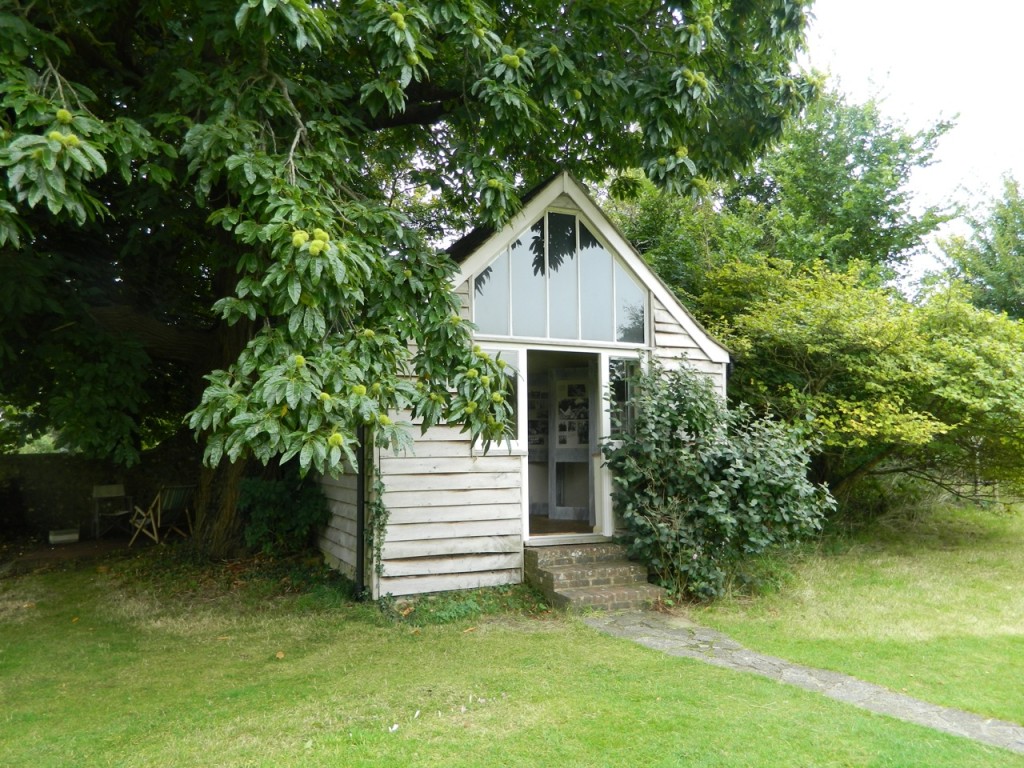
If you read Virginia Woolf’s excellent diaries, she talks a lot about her house at Rodmell, Sussex, from which she can walk out into the country, along the River Ouse, and at which she had the ‘room of her own’, a little writing lodge in the garden, where she produced most of her most famous works.


Tove Jansson’s Island
Perhaps a bit extreme, but I can see the appeal of an ‘island of one’s own’. The island is as much a character in Jansson’s books as anyone else, if not the most enduring one.
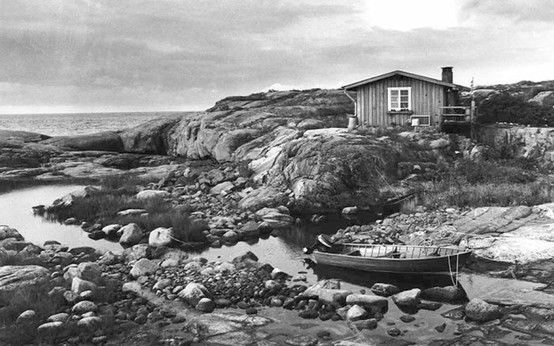

What is interesting about all of these writing places, and when you start reading more about writing rooms, is how many writers had sheds or huts completely separate to their home to do their writing in. I suppose this makes a lot of sense: going to the shed at the bottom of the garden creates a break between home responsibility and the job of writing and in that distance between back door and shed door the writer can emerge. Creating a space in which you write, and only write, is something that perhaps helps to ease the journey between the ordinary version of you and the you that creates. It’s an interesting idea. My writing room isn’t just a writing room, it’s a shared space in which I can write and my family can read and play games and share quiet time with each other. It’s not perfect, but it is a lot better than where I was before. But writing this blog has got me wondering: perhaps there is room in my garden for a shed...?


Sunday, 15 June 2014

Burial Rites by Hannah Kent


I’ve been avoiding Burial Rites. I’m not sure entirely why, but I avoided the chance to buy it cheaply and of all the Bailey’s Prize listed novels it’s been the one that least interested me. Perhaps it is because it has been touted as a ‘crime’ novel (which it is) and perhaps it is because of the cover which has those awful ‘Gripping’ says Kate Mosse (another writer I’ve avoided, probably quite unfairly. Now on the list, along with Tracy Chevalier who I’ve similarly avoided. Bad me. Reforming, reading more openly), A must-read’ says Grazia magazine (avoided, not unfairly I think). It’s a cover that smacks of desperation. ‘Please read me’ it says. I walk the other way.

Anyway, when I was picking up some books I really wanted to read from the library I saw Burial Rites sitting on the ‘new books’ shelf, untouched, and thought ‘oh go on then’ and I did, and this whole blog is a lesson to myself to never, ever judge a book by its cover and never judge a writer before you read them.

Burial Rites is based on a true story, the story of Agnes Magnúsdóttir the last woman to be executed in Iceland. Agnes is accused of the murder of two men, Natan Ketilsson a farmer and herbalist and Péter Jónsson a visitor. Her accomplices are Fredrik Sigurdsson the son of a local farmer and Sigrídur Gudmundsdóttir a fellow workmaid. The men were violently killed and then the farm set on fire to disguise the crime. The novel draws on real letters from the time, though much of Agnes’s life, and in particular her final days, are fictionalised.

Before her execution, Agnes was sent to live with a District Officer, Jón Jónsson and his family on their farm. The story picks up from the time that Agnes is transferred to the farm.  The District Officer’s wife Margrét and her two daughters Lauga and Steina are unhappy with the idea of a murderess living at their home, as are their neighbours. A priest is assigned at Agnes’s request, an Assistant Reverend Thorvardur Jónsson who is mystified to find that Agnes had requested him personally. These key characters descend upon Kornsá where Jón Jónsson’s farm is situated.

Not surprisingly the story begins quite coldly. Agnes is tolerated but unwanted, and she fits quietly into the role of servant, saying little and offering nothing more than labour. Yet Kent reveals the burning heart that lies beneath the quiet, compliant exterior. Agnes’s back story is revealed though her own, quiet remembrances and the gradual opening up to the inexperienced Reverend Thorvardur Jónsson, Toti. Through Agnes’s story we learn more about the terrible burden of poverty, at a time when orphans or abandoned children, often the bastard children of landowners, were tossed on the mercy of local charity. This often meant service work which for women often meant rape or sexual servitude both to the master and the other servants. As Agnes’s story develops, we discover that her failing, if any, was pursuing love in a place and time when none was offered nor, it seems to some views, due.

As Agnes’s story develops, so we see the sympathies of those around her turning. Slowly she stops being seen as the ‘murderess’ and becomes Agnes. Yet she is still awaiting fulfilment of her sentence of death. As the older and more learned of the two workmaids, perhaps also the less pretty, the heavier weight of blame is laid at Agnes’s door. Whilst the District Officer, Björn Blöndal, seeks leniency for the young and guileless Sigrid, Agnes is to serve her sentence as an example to others. It is, as Agnes notes ruefully, because she is too knowing that she must suffer. An intelligent, educated servant woman is something to be suspected and feared.

Through Agnes’s story Kent reveals the destitution of poverty, the sad burden placed on women in society, the ways in which people use, and abuse, other people for their personal gain. Around these stories Kent weaves the Icelandic winter with its endless hours of darkness, the fearsome beauty of the Northern Lights, the isolation and the deathly cold. It is a beautifully written book, mindful of the Icelandic sagas (Kent mentions she referenced the Laxdæla saga, in particular the line ‘I was worst to him I loved best’ when reflecting on Agnes’s story) and unafraid of dipping deep into this dark story from history. The prose is stunning, like here as Agnes reflects on her fate:

“He is so kind, he is reaching around me, he is pulling my body closer to his, but I don’t want him near. His mouth is opening and shutting like a fish, the bones of his face like knives under his skin, but I cannot help him, I do not know what he wants. Those who are not being dragged to their deaths cannot understand how the heart grows hard and sharp, until it is a nest of rocks with only an empty egg in it. I am barren; nothing will grow from me any more. I am the dead fish drying in the cold air. I am the dead bird on the shore. I am dry, I am not certain I will bleed when they drag me out to meet the axe. No, I am still warm, my blood still howls in my veins like the wind itself, and it shakes the empty next and asks where all the birds have gone, where have they gone?”

It is an emotional story, told without sentimentality. I’m not ashamed to say that I was moved to tears towards the end, as Agnes is being taken to the axe and a man, a stranger accompanying her on her journey, gives her some brandy. “’Drink it all, Agnes,’ the blond-haired man said. ‘I brought it for you.’” It brought to mind the thought that whilst Agnes may have lacked, or felt she lacked love, there was always o possibility of kindness, though it is kindness, often, rather than anger or abusiveness, that brings us to our knees. And though Agnes’s fate was well known, I still found myself hoping that there was a way out for her, somehow. As did she, I suppose.  

Hannah Kent is another example of the fantastic skill and storytelling-ability coming out of the antipodes right now along with Eleanor Catton’s excellent The Luminaries and Evie Wyld’s peerless All The Birds, Singing. It’s really caught my attention. They manage to combine excellent storytelling with beautiful, complex prose and an almost flawless delivery. All three of those writers have written engaging, powerful stories that simply lift the reader along. I will be watching out for more work from all three.

Burial Rites receives an epic 10 out of 10 Biis.

Friday, 30 May 2014

Reflections on writing: the value of keeping a journal

I’ve kept journals on and off during most of my life. Usually journals have appeared at times when I’m stressed or unhappy, and I’ve used them to help me make sense of what I’m feeling and put things into context. I’ve kept a writer’s journal before too, using it to jot down my thoughts about stories or poems I wanted to write, or writing snippets of prose or observations. I’ve never been particularly obsessive about it, but there’s usually a notebook to hand and now and then I’ll write something in it and that’s been about it.

When I read Dorothea Brande’s book ‘Becoming a Writer’ one of the exercises she poses is this, designed to help you access your ‘unconscious’:

“The best way to do this is to rise half an hour, or a full hour, earlier than you customarily rise. Just as soon as you can – and without talking, without reading the morning’s papers, without picking up the book you laid aside the night before – begin to write.”

Sounds easy right? I thought I’d give it a go and over the course of several days began to realise how impractical this was for me. Firstly, I don’t ‘rise’ alone. My husband ‘rises’ with me, so getting up 30 minutes or an hour earlier than usual completely wrecks the morning routine. Secondly, I don’t ‘rise’ alone so the whole ‘without talking’ business is virtually impossible without seeming sulky or ignorant. Plus I like talking to my husband in the morning. Then there’s the terrible habit I’ve developed of checking my e-mail before I get out of bed in the morning. Yes, I know, it’s a terrible, rotten habit, but I’ve found it helps me wake up more quickly. So the whole not talking, not reading business just doesn’t work for me.

So I adapted the exercise (okay, yes, I cheated) and instead I decided to write in my journal during my train journey to work in the week, and first thing after getting up on a weekend. I’ve found this habit much easier to develop and, surprisingly, I’ve found it highly beneficial. It has taught me a lot about me. For example, one of the first things I noticed was how hard it was to actually write anything in the morning, when little had happened. I realised that often I write in response to something. That writing is often a reaction. Consequently for the first few mornings I had very little to say. The more frequently I wrote, however, the easier it became and now I find my pen flowing freely as my thoughts unwind and my ideas slip from my mind onto the page. Now I am generating thoughts rather than reacting to external stimulus. I have become sentient (at last).

Another discovery was that writing helps me to sort and organise my thoughts. I already kind of knew this, but writing regularly has cemented that understanding. If something is troubling me, or if I can’t work out how I think or feel about something, writing it down brings sense to it. Perhaps it is the effort of attempting to cage my thoughts in the structure of language that helps me draw them into a more ordered form.

Writing regularly also aids the flow of ideas. I have found myself uncovering a number of ideas through the random, unformed ramblings of my morning thoughts. As a result I have more ideas than time to write them (or skill, for that matter). In the course of my reading of Virginia Woolf’s diaries, I have noticed a similar trend coming through her own thoughts. It is almost as though allowing the mind to wander, to follow its own path, helps you to uncover the bright spots swamped beneath the daily mundanities.

More importantly, writing in my journal has enabled me to write, generally, more freely. Making an effort to write every day makes it easier to write every day, weird as that sounds. Practice makes perfect. And it’s had other beneficial effects too: I find it easier to concentrate in the morning, easier to focus on my work. I have got into the habit of making myself little ‘pledges’ each day, simple things like: I will write today, I will go for a walk, I will meditate. Nothing too ambitious. Writing it in my book, pledging it to myself, makes it much more likely that I will deliver on my pledge.

When I’ve been sad before, or stressed, when I’ve been using a journal to help me find my way through a thorny patch of life, I’ve always found it useful. When I’ve felt miserable, I’ve found that writing the good things that have happened in my day a great way of turning my thoughts around to a more positive view. That writing in a journal every day helps to train the mind towards writing shouldn’t be that surprising, yet it is. And the only way to understand how much it could help is to do it. Go on, try it. It might surprise you too. Just remember to do it every day. 

Reading Ambitions

Facing a week off work, the first thing I invariably do is give some considerable consideration to the books I will read whilst I am off. I am never quite sure why I do this, as my reading capacity when I am not working is always less than when I am. Something to do with spending an hour and forty-five minutes on the train every day, with little else to do than stare out of the window. Yet this activity gives me great pleasure. It is a great joy to sort through my books, considering and selecting, taking books from the shelves and putting them back again before settling on my final choices. Generally there are three: a couple of fiction books, maybe, and a non-fiction, perhaps some poetry. Rarely do I work my way through everything I take to read.

(It occurs to me that this is a pleasure that e-readers take away from the average bibliophile. Where is the joy in selecting if you have your whole library with you anyway at all times? Another nail in the coffin.)

Faced with a week off work I start thinking about my reading ambitions. I think it is right to call it ambition because my goals are lofty and I often aim higher than the extent of my reach. I want to read the entire works of Virginia Woolf, for example, I want to read until I know what it is to be Virginia Woolf, until her works are quotable and recallable to me. I want to read the entire works of George Eliot in the same way, and whilst I’m at it Jane Austen and the Brontës. I want to read the full catalogue of writers like A. M. Homes and Ruth Ozeki, Marilynne Robinson and Donna Tartt. I want to absorb myself in the works of Jeanette Winterson, every passion-filled full stop of them, and compare and contrast them to the scope and breadth of Elena Ferranti’s work. I want to read a book written by a woman from every place in the world, from places as far afield as Haiti and Mexico, Laos and Azerbaijan. I want to dig into female non-fiction, covering subjects from history to biology, from philosophy to people trafficking. I want to learn about far-flung islands and read about riding a bicycle from Ireland to India, being a farmer or opening a book shop on a narrowboat.

I want to read the entire works of J.M Coetzee and Don DeLillo, delve into the weird and highly focused world of Nicholson Baker. I want to explore the works of Kazuo Ishiguro and Zadie Smith. I want to read Dickens (but never got around to it) and Hardy and Balzac and Zola. I want to know, not just read but KNOW, the works of Yasunari Kawabata in all their beauty and sadness, their delicacy. I want to absorb the world’s mythologies until they become a part of me, the Greek myths, the Eddas and Sagas, Shanameh, the Mahabharata. Then there are new books. I get excited about the news that David Mitchell is releasing a new book this year (The Bone Clocks) and Marilynne Robinson (Lila). I see reviews of books like The Miniaturist and Elizabeth is Missing and feel, somehow, that I have to read them. Add them to my list.

There aren’t enough days in the week or hours in a day. Sometimes it is almost paralysing, this desire to consume, to absorb stories. I finish a book and move on to the next one, sometimes reading two or three at the same time (not literally but, rather, concurrently). I get frustrated at how slowly I read, how little time I have to absorb the ever-growing stockpile of stories. I get angry at how superficial my reading is, how little I can really take in. Deep appreciation of literature requires deep reading, but with so many books and, more importantly, so many I want to read how can it ever be possible to devote the time required to a real deep reading? And which books? Would I be better absorbing the literature of Tove Jansson than Donna Tartt? What about Tolstoy or Dostoevsky? How is it possible to decide which books, which writers, which stories are worthy of that level of devotion?


So I keep reading, and I dream of a day when I have a library consisting of exactly six books, their covers worn, their contents fading, but which have become my lifelong companions. The books I cannot do without. I dream of it, but I don’t see it happening. Instead I will be the woman crushed under the excessive weight of her library, the hundreds of books unread that can never be read that fall like a stone on her head taking every word with them, and it all will have been for nothing.