Sub-heading

A blog for everything bookish

Saturday, 25 January 2014

Ten dead female writers everyone should read

I don’t know if you’ve heard, readers, but 2014 is the year of reading women. Yea-ha! It’s about time. And how rotten that it takes the likes of Twitter to highlight the under-representation of women in the literary world. I’ve said it before, so won’t labour the point, but there is an inherent sense in the literature that there is ‘fiction’ and ‘women’s fiction’. There are books that are ‘universal’ (e.g. written by men and about things that interest men and thereby everyone) and books that address ‘women’s issues’ (e.g. not of interest to men). Or put another way, half of the population take an interest (or perhaps are forced to take an interest) in the other half, and half of the population don’t. It seems to me that the latter half are losing out.

Of course I know it is not that simple. Many men read and enjoy and share and promote books by women, and many women almost exclusively read books written by men. That’s the thing with gender issues, they’re never really straightforward or easy to resolve. But what is straightforward is that there are many, many, many wonderful female writers out there and they should be read. And they’re not hard to find either (you can find many on my blog, right here). Please read them.  I am prepared to beg (or nag. I am better at nagging).

So, continuing not to labour the point, I’ve compiled a list of dead female writers that everyone, EVERYONE, should read. And if you read the list and think ‘but where are the Bronte’s and Austen and Woolf and Eliot and Agatha Christie and Doris Lessing?’ that’s deliberate as I’ve assumed most people are already familiar with the more well-known female writers (though if you weren’t I’ve sneakily mentioned them anyway. Did you notice?). So, without further ado, here’s my list. Who would you add?    

Murasaki Shikibu
Did you know that the world’s first credited* novel was written by a woman? She’s worth reading for that accolade alone, but fortunately her one, ground-breaking novel is more than just that. The epic Tale of Genji is a Japanese classic, telling the story of the ‘shining Genji’, illegitimate and favoured son of the Emperor. If you ever wondered how long that feeling that ‘things just aren’t as good as they used to be’ goes back, this tale sites it at least some eras earlier than the 11th Century. A beautiful and fascinating, and rather long, story that’s well worth the time it takes to read.  

Simone de Beauvoir
It always depresses me that the name Simone de Beauvoir is often followed by, you know Sartre’s girlfriend, because this remarkable women was much, much more than that. Perhaps most famous for her feminist critique, The Second Sex, which provides a remarkably detailed and quietly scientific overview of the problems women face in Western culture. However, for me the book that simply blew me away was the short but disturbingly powerful The Woman Destroyed which comprises three short pieces examining three women’s stories. There was something about that book that really woke me up, made me realise that it was not enough to know that the male-dominated culture made it more difficult for women to live successful and happy lives, but also women’s complicity within it made it less likely to change. In her work de Beauvoir presents the idea that women are responsible for achieving their own transcendence, for reaching beyond the limits society offers and grabbing more. She is, perhaps, the first true feminist, but don’t be misled into thinking that means her work is solely about or for women. Instead she is an insightful writer who belongs well within the Existentialist movement. Not on the sidelines, or behind her more famous partner.  

Elizabeth von Armin
Because The Enchanted April. If you can find a nicer, happier, lovelier, more wonderfully sweet and soul-cheering book anywhere I will eat my blog.

Sigrid Undset
Undset is a Nobel prize winning novelist. Do I need to say more? Well, perhaps it is worth mentioning her epic novel Kristen Lavransdatter, set in the 14th Century, which follows the life of a women from a well-to-do family who defies social expectation and marries the man of her choosing...and breathe. What follows is a love story, a story of freedom of choice over social expectations, how following your chosen path can be difficult, disappointing and yet marvellous and rewarding. It’s a whopper, but stunning, absorbing and beautiful.

Iris Murdoch
They don’t refer to her as a philosopher without reason. Murdoch was a prolific writer whose work is peppered with ideas, concepts, musings, psychology all wrapped up, often, in an engaging story. My personal favourites include The Bell, The Unicorn and the marvellous Black Prince which is a fantastic example of the unreliable narrator. Her magnus opus, The Sea The Sea is still on my ‘to read’ list. Hopefully I’ll get around to it this year. Also worth checking out the biopic movie starring the wonderful Kate Winslet and incomparable Judi Dench.

Anais Nin
A long time before Fifty Shades of Grey there was Anais Nin. In fact that’s a poor comparison because there is NO comparison between Nin and the juvenile drivel that shall not be mentioned again. Nin is a writer with her self on her sleeve. Honest, passionate, self-aware, explorative, she gained fame writing short, erotic stories which have since been bound-up in two collections – Little Birds and Delta of Venus – which explore a vast array of erotic themes (and make for quite nicely titillating bedtime reading). Her famed interactions with Henry Miller are covered in her wonderfully biographical story Henry and June. An early example of life reflecting art, or art reflecting life, or something like that. An absolute pleasure to read.    

Angela Carter
Angela Carter, I think, was my first grown-up discovery. Her writing is voluptuous, her characters often unsympathetic and their relationships awkward and combative. My absolute favourite of her works is The Magic Toyshop, a terrifying coming of age story of poor spoiled Melanie who steals her mother’s wedding dress and destroys it, only to find her parents destroyed too. Orphaned along with her brother and sister, she is sent to live with her Uncle Philip, a man she has never met, his strange, mute, wife and her brothers who live together in a degraded part of London. Philip is a toymaker, the proverbial puppet-master, and they live above the toyshop. It is a dark and magical story exploring the terror of self discovery and the unexpected places love can be found.

For a great introduction to Angela Carter, try her short story collections – The Bloody Chamber and Black Venus. In them she reworks a number of well-known stories from a female perspective: Little Red Riding Hood, Dracula, Beauty and the Beast, Puss in Boots, but it is the richness of her language which is most memorable. This from The Bloody Chamber:

Even when he asked me to marry him, and I said: ‘Yes,’ still he did not lose that heavy, fleshy composure of his. I know it must seem a curious analogy, a man with a flower, but sometimes he seemed to me like a lily. Yes. A lily. Possessed of that strange, ominous calm of a sentient vegetable, like one of those cobra-headed funeral lilies whose white sheaths are curled out of a flesh as thick and tensely yielding to the touch as vellum. When I said that I would marry him, not one muscle in his face stirred, but he let out a long, extinguished sigh. I thought: Oh! how he must want me! And it was as though the imponderable weight of his desire was a force I might not withstand, not by virtue of its violence but because of its very gravity.” 

Ah!

Marlen Haushofer
I’ve read only one book by Haushofer, The Wall, which is perhaps her most well known and boy did it stick with me. A quiet tale of a woman trapped inside a valley behind an invisible wall. She suspects that everyone outside is dead. Under this bubble she wrestles with survival as well as the downsides and benefits of being outside society. Alongside her daily trials there is an unknown menace; someone else is in the dome, a man she suspects, and whilst there is no direct interaction the presence of this unexpected and unpredictable third party creates a terrifying edge. It is a powerful book which reflects interestingly on the pressures of society at large, and the ways in which we are threatened and freed by being outside of it.

Tove Jansson
Well, it wouldn’t be my blog if I didn’t mention her at least once. READ HER. I can’t say it loudly enough. She’s amazing.


*I say ‘credited’ because it probably wasn't the first novel ever written, but is often cited as being the first. 

Saturday, 4 January 2014

Ten contemporary male writers everyone should read


This list was pretty difficult to put together because actually I’m not that well informed when it comes to contemporary male writers. In point of fact most the male writers I really like are dead, which is a bit of a shame for me (but perhaps more of a shame for them). Plus I’ve been so heavily focused on unearthing those great contemporary female writers I’ve lost touch with the men. Perhaps that is something I will rectify this year (though I do have some fairly heavy reading goals already). Though I’m aware of some names floating around out there without having read them it would be wrong of me to pin them here as worth reading (though possibly they might be...they might warrant a quick mention somewhere). So I should qualify at this stage that some of the writers might be a little bit on the fringe, but I’ve read them and found them worth it and perhaps the list is better for not being comprised solely of the usual suspects.

So, without further delay, here is the list.  

David Mitchell
Before you get confused that’s David Mitchell the writer, not David Mitchell the TV personality. Made famous by the amazing Cloud Atlas, described, quite fittingly, as a Matrioshka doll of a novel. But it’s much more than that. It’s an experiment in form, it’s a showcase of Mitchell’s talent and intelligence, it’s fun. However, Cloud Atlas is not Mitchell’s only novel, neither is it his only great novel. To gain a full appreciation of his skill it’s worth reading through his work: the loosely biographical Black Swan Green, the eclectic and brilliant Number9Dream (I challenge you not to fall in love with the quirky loveliness of Goatwriter), the contemplative Ghostwritten (my personal favourite), the historical masterpiece The Thousand Autumns of Jacob de Zoet in which Mitchell shows both his joy and mastery of the English language. Mitchell has always struck me as a writer who lives in a globalised world, a fusion writer bringing together the East/West cultures into a new kind of vision. It is perhaps not too surprising to find he spent time in Japan and has a Japanese wife (who is not me, sadly), when the flavours of Japan spice his work so liberally. In many ways Mitchell is a writer of blending; he shows you the forms, sticks to their rules, then stitches them together in a way which shouldn’t work but it does. It always does. 

J M Coetzee
Quite a different writer, but a master all the same. Coetzee is sharp as the knife he cuts his characters with, his prose so clean you can see your face in it. His work is intelligent, insightful, often bleak. His characters are unlikeable (but I think we’ve established before that likeability is not a necessary trait). Where Mitchell is joyful, Coetzee is a surgeon – all precision and sharp light and cutting. I think you probably get my point. If you enjoy comforting reads then Coetzee isn’t for you, but if you enjoy work that is perceptive and intelligent, with an eye on the darker side of life and a slightly parable-esque edge to it, then he’s your man. Disgrace, his seminal novel, reflects post-apartheid South Africa with an unforgiving eye and is not without controversy. It is not an easy read, but perhaps an important one.  

Don DeLillo

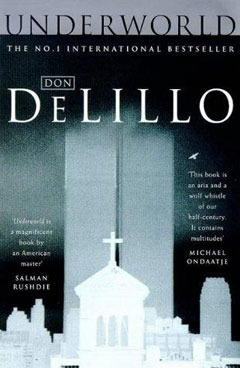
I may be slightly influenced by the knowledge that Don DeLillo was a key influence for David Mitchell in his work, with Mitchell going as far as stealing entire lines for his novel Cloud Atlas (and crediting it, to be fair). My first encounter with DeLillo was less than auspicious. I read a novel called The Body Artist and I hated and slated it and swore it would be a long time before I read a DeLillo novel again. It was a couple of years later when I picked up a cheap copy of Cosmopolis, intrigued largely by the movie which was due to be out that year (and which I have never seen). I took it on a camping holiday and spent three short days completely altering my view of DeLillo. I was mesmerised. I read it once, then read it again. And again. I went back to passages, phrases like ‘meat space’, ‘the zero-oneness of the world’. DeLillo’s writing has a very transcendent quality to it, a rhythm that is like a chant or a prayer. It almost doesn’t matter what the words say, it carries you along on a dreamlike wave and you go with it. He has a way with dialogue which is simultaneously completely unnatural and yet authentic in a way that makes ordinary speech seem empty and worthless. He’s basically great. Read him.   

Tom McCarthy
Known for his Booker shortlisted novel ‘C’, Tom McCarthy writes from an avant gard literary tradition. He has written only a few books, but all of them pack a punch. My personal favourite, one that really sticks in my head for some reason, is Remainder. This is the story of a man who is hit by ‘something’ that has fallen from the sky, and as a result he has had to relearn to use his body. He is also awarded substantial sums of money in compensation. He discovers that certain incidents or ideas, and the repetition of them, have a strange effect on him and uses his money to make these happen over and over continually. Not surprisingly this spirals into something quite terrible. There is something strange and addictive about this book; it is one I have returned to more than once (perhaps scarily like the character in the book) and each time I’ve found it equally compelling. His other novels ‘C’ and Men in Space deal with much broader themes. There’s a nihilism to his work which may or may not be linked to his organisation the ‘International Necronautica Society’, explorers in the adventures of death.  

Haruki Murakami
Murakami. I have a mixed relationship with Murakami. He has written a lot of books, many of them excellent. He’s also written some duffers. He sits somewhere between populism and excellence and each novel that is released sits somewhere between them too. He is a writer worth reading, worth exploring. There is probably something for everyone in Murakami’s books. His protagonists are often lonely or loners. His books explore themes of isolation and self-discovery. There is often jazz, and a lot about food. There are cats and people that eat their heads. Philosophy, unexplained phenomena, suicide. Wells, a lot of wells. I was disappointed with 1Q84, largely on account of the male sexual fantasy drawing of the main female characters and the baggy plot which, with a careful edit here and there, would have been fantastic. Many people loved it, however. In my opinion, Murakami is much better in his older works, and at his best in his only factual work Underground which centres around the sarin gas attacks on the Tokyo underground, largely through interviews with survivors, family members of victims and members of the Aum Shinrikyu cult that perpetrated the attack. Other great books in Murakami’s canon include The Wind-Up Bird Chronicle, Hard-boiled Wonderland and the End of the World, After Dark and Kafka on the Shore.

Cees Nooteboom
Now here’s another writer who barely drops a poor word. Dutch writer Cees Nooteboom, also known for his travel works, has a small catalogue of extremely excellent works. The first of his I encountered, Lost Paradise, is a tiny but mind-blowing book that I read, read again and then again for good measure. Drawing on Dante’s Paradise Lost, it follows the interlinking stories of two people: a Brazilian girl who is gang raped and retreats to Australia with a friend, and an aging man, a writer, who goes on a retreat to find himself. It is a book about identity and angels, the wonder of the desert, and how we find ourselves in unsuspecting places. It is a book of pure beauty, terrifying and wondrous. Rituals is a quite different novel, following the fortunes of Inni Wintrop who in the opening pages hangs himself (unsuccessfully). It is a book filled with dark humour and unexpected people. As an introduction, you might want to try his book of short stories The Foxes Come at Night which is equally excellent (especially the one about the tortoise).

China Mieville
I’ll admit to having only read one of Mieville’s books and that one is The City and The City. I would like to read more. Mieville blends science fiction, horror, detective fiction and weaves his own magic around it, creating something quite new. The City and The City tells the story of a detective investigating a death which crosses from one city to another city, both of which occupy the same space. Is your mind bent yet? It will be. Mieville is a writer for the urban generation, setting his books in cities known (London) and unknown. There is no one quite like Mieville, he writes in an imaginative space, conjuring an alternate reality which is both strange and believable. He reminds me, I think, of what Ballard would be if he was writing now.

Simon Crump
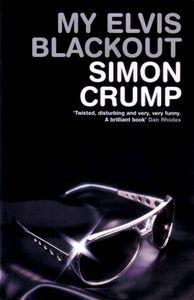
This, I’ll admit, is my wildcard. Again, I have only read one novel by Crump but it is My Elvis Blackout and honestly I don’t think I’ve read a weirder or scarier or odder or more mind-blowing book than this in my lifetime. It’s bonkers. In it Crump presents us with an alternative Elvis or, in fact, several alternative Elvis’s. Yes, that’s right, the Elvis. Uh huh. Other cameo appearances come from Barbara Cartland and Chris du Burgh. Someone dies (everyone dies). It’s weird but brilliant.

Kazuo Ishiguro
Ishiguro writes such interestingly complex characters. His book The Remains of the Day, which is also an excellent movie, presents the perfect embodiment of mannered duty in the butler Stevens and yet it is a duty which is old fashioned and somehow wrong and which leads him to make terrible choices. Never Let Me Go is quite disturbing, again perhaps largely due to the complicity of the characters in their own situation. It is hard to discuss it without revealing too much. Like Mitchell, Ishiguro blends a kind of Japanese-ness and English-ness and creates, perhaps, the worst case scenario of both. A brilliant yet complex writer, hard to classify but well worth reading.

Nicholson Baker
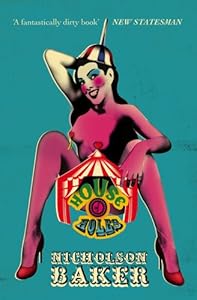
There are two sides to Nicholson Baker’s work: the obsessive compulsive, detail heavy, mundane and yet not mundane, and then there’s the porn. It’s relatively easy to figure out which is which. The Mezzanine, for example, is the story of a man travelling an escalator having gone to buy shoelaces. Obviously that the obsessive-compulsive type. The Fermata is the story of a man who can freeze time and uses it to undress women and masturbate. That’s porn. What links them both is Baker’s distinctive voice which despite the mundane/porny theme of the books is charming and engaging and often very funny. Not to everyone’s taste, but definitely a unique writer with a unique voice, worth watching out for.

So that’s my list. I’m pretty sure there are some quite glaring omissions. You may note that Philip Roth makes no appearance, which is largely because Roth leaves me cold though I am aware many people think he is amazing. Martin Amis is another; there was a time when I liked Amis but that time is long past. He is another who has, I think, passed his prime. Will Self I haven’t read, neither have I read Karl Ove Knausgaard though I hear good things about him. Which writers would you add to my list? 

Saturday, 28 December 2013

Reformation: reflections on a compulsive book hoarder

It is almost 2014 and, to mirror the tradition of the time of year, I’d just like to reflect a moment on the year that was 2013. 2013 will always, now, be known to me as the year I realised I’d become a compulsive book hoarder and decided to do something about it. Like many self-discoveries, this one has been a journey and a journey that has not ended and will not end until I do. I have hoarding compulsions. Compulsions are rarely defeated easily (and if they are it is more probable that they have simply been mis-described, exaggerated).

I have stopped buying books, or rather I have largely stopped buying books. I consider this a considerable improvement. I have given in, now and again. I am starting to recognise the key danger signs: a winsome look from my daughter (a future hoarder if you ever saw one, as the pile of unread ‘How to Train Your Dragon’ books is a testament to); days when I’m feeling stressed or harried and I wander into the bookshop for a moment’s respite amongst the shelves; the death of a favoured author (which is my key excuse...I mean reason...for buying The Good Terrorist by Doris Lessing, which was really awfully good and a worthwhile buy). I will confess, now, to having bought several books in this past week. It was my birthday recently, and I was given some money with which to buy some books so I finally invested in The Story of the Stone, which I’m very much looking forward to reading. But that’s it. The money is spent. No more.  

I am starting to develop coping mechanisms, the most important of which was rediscovering the library which I remain ashamed to have forgotten. I must, at this point, take a moment to commend the absolute excellence of the Lancashire Library Service, which provides a brilliant service to the community. They have saved me several times from an impulsive purchase. Instead my first port of call is now always the library catalogue and I have been massively impressed at how quickly the Lancashire Library Service responds to a popular new book. Through them I have read most of the Booker nominated novels (those that I hadn’t already purchased before I stopped myself), Donna Tartt’s The Goldfinch (marvellous) and the fantastic Booker winner Eleanor Catton’s The Luminaries. The ability to reserve a book, even if I have to wait weeks for it, has been enough to assuage my urge. If there is one thing I have learned this year it is this: use your library. Even if only occasionally. They provide a magnificent service that helps so many people. At a time when they remain under threat, boots through the door will help to preserve them. They have books. They want you to take them.  

Re-reading is something I really want to work on next year. There are many books I would like to read again, and probably a small core of books that I would love to become a part of my being. Having whizzed through The Luminaries and The Goldfinch I would definitely like to read those two again (aided, I should add, by the kindness of a friend who gifted me with my own copies for my birthday). A Tale for The Time Being is another repeat I’d like to make, alongside other more established books in my collection: Lost Paradise and Rituals by Cees Nooteboom, The Last Samurai by Helen DeWitt, The Magic Toyshop by Angela Carter, The True Deceiver by Tove Jansson, Remainder by Tom McCarthy, Ghostwritten by David Mitchell, Jane Eyre to name but a few. I could spend the whole year re-reading but I think I need to balance the re-reads against the unreads so my ‘to-read’ pile continues to shrink. And then there are the books yet to be. As always, my reading ambitions exceed my time and ability.


I haven’t read Proust. I read the first book of Proust and realised that if I stick to my pledge I may never buy another book again. I may simply be too young (not that I get to say that much anymore) or maybe I’m not of the right frame of mind, but I found his meanderingly pointless repetitiveness spectacularly unappealing. It doesn’t really matter now. I have learned so much about my book hoarding proclivities that I don’t think I need the barrier of Proust to prevent me. What I want to do instead is make sure that my buying matters, that it makes a difference. I am a proud subscriber to And Other Stories, a not for profit organisation that publish some amazing books on the back of individual subscriptions and I will continue to support this organisation (and encourage others to do the same) in spite of my commitment to hoard less. I would like to set aside a little money each month and allow myself a single purchase, but instead of buying from Amazon or The Book Depository or one of those other internet behemoths, instead I will head down to my local independent bookshop (Ebb & Flow in Chorley, which carries an excellent albeit small selection of books) and spend my money there. I feel much happier spending a little more but putting money into a local community business. There are so few these days, and my contribution will be small but hopefully valuable. Overall I intend to spend less on books, but make my purchases more considered and more carefully. I think that’s a reasonable goal, for the person who once bought 47 books in one go.

Sunday, 15 December 2013

A touch of poetry: Mark Strand


You don’t hear of or see many people reading poetry these days; I guess it’s largely out of fashion. If you look hard enough you might catch the odd person admitting to reading some for school, or university, and then only sheepishly and rarely with an admission of enjoyment. ‘Oh, I read it because I had to,’ they’ll say. ‘It’s boring,’ or ‘I didn’t get it.’ They avoid eye contact, change the subject. I remember, once, telling someone I had an entire book of poetry and they looked at me, a quizzical uncertainty in their eye. ‘A book of poetry?’ they said. ‘Why would you read a whole book of poems?’ When I explained I owned many books of poems, it killed the conversation (thankfully, I should say).

Poetry, for me, occupies the same kind of space as music or art. It is something to be returned to, repeatedly, to be experienced as opposed to consumed. It is something that etches into me gradually, each reading bringing me something new and different. I am not too troubled by lack of understanding, which is not to say that I understand poetry naturally but rather I am willing to wait for understanding, in whatever form it takes, to seep into me gradually, over a course of weeks, months, years or decades. Or perhaps that understanding will remain forever out of my grasp, as is true of so many things. This does not trouble me. I do not need, or especially desire, understanding to enjoy or appreciate something. Perhaps understanding is a bonus, or not. Perhaps understanding kills the mystery. I do not find it strange that people read poetry, it only saddens me, a little, that so many do it so furtively and yet those same people might think nothing of listening to a song over and over until the beat of it sang in their veins and celebrating it.

It is perhaps because repetition, re-reading, is so much at the forefront of my mind these days that I got to thinking about poetry. Poetry, I find, benefits from multiple readings and often from readings that are separated by distances in time. Not just time, but also cognition. I am a different person now, have a different understanding and experience, to the me that read Boris Pasternak, so tentatively, at 18. I have mentioned this before, but there is something useful, marvellous even, in making that re-connection with the earlier versions of yourself. Through this we can learn how we have grown, yet remain the same. The me that reads poetry now is more confident than 18 year old me, but the gulf of understanding has not narrowed that greatly. This is both humbling and encouraging. It means that I still have space to grow, I must still seek and remain open. It means that in all my years of experience, I still have a way to go. I cannot assume that because I am older I know everything I need to know.

It was in this train of thought that I returned to the poetry of Mark Strand. Mark Strand, in case you have never encountered him, was once Poet Laureate of the United States, and writes poems which are landscapes or logical puzzles, which explore the connections between inner and outer self, our relationships with life and death. There is a lot of fun in his poetry, and much uncertainty. Some of his poems are extremely unsettling, and yet most are life-affirming, and over the course of the years (he has been writing for many, many years) there is a range of poetry such as it should suit just about anybody. For me, the focus has been on two collections: Darker and Selected Poems (Carcanet Press), largely because they are the two I own. If you want a taster of Strand’s poetry then the Carcanet Press book is a good place to start. Darker, however, is a collection you can seep yourself into and never have to come out. When I am feeling bleak, or uncertain, it is a collection I return to; I can lose myself in the tricky language, the linguistic puzzles and surprising precision. I can find myself again amongst the ‘Black Maps’, in the mysterious and surprising unravelling of truth within the questions he poses. I can laugh at his silliness, and the wit and wonder he displays in all of his work. My favourite poems, if it is possible to choose just a handful, are Black Maps, The Remains, The Prediction, My Life By Somebody Else. As a sampling, here is an extract of Black Maps:

 
Black Maps
 
Not the attendance of stones,
nor the applauding wind,
shall let you know
you have arrived,

nor the sea that celebrates
only departures,
nor the mountains,
nor the dying cities.

Nothing will tell you
where you are.
Each moment is a place
you’ve never been.

You can walk
believing you cast
a light around you.
But how will you know?

The present is always dark.
Its maps are black,
rising from nothing,
describing,

in their slow ascent
into themselves,
their own voyage,
its emptiness,

the bleak, temperate
necessity of its completion.
As they rise into being
they are like breath..”.  


A full version of the poem, and a little more info about Strand, are available over at the Poetry Foundation website, which includes a sampling of his poems.  http://www.poetryfoundation.org/bio/mark-strand#poet

Strand’s poems have a modern, present feel although some of them were written over 40 years ago. There is something comforting about that, something wonderful. Perhaps it is Mark’s own words, from Seven Poems (also in Darker), that explain, better than I ever can, why poems are something to be returned to, over again, regardless of how uncertain they make you feel, how unsettling. Why poems are something which we should allow to become etched into our very bones, reminding us of what we know, which is nothing. Read a poem today, and then tomorrow. And next year when you’ve forgotten it all, read it again.

 
“I have a key
so I open the door and walk in.
It is dark and I walk in.
It is darker and I walk in."

Mark Strand (Darker, 1976)


Sunday, 8 December 2013

Great books to read over Christmas


‘It’s starting to look a lot like Christmas’ as the song goes. I have a few extra days off over Christmas and whenever I have a few extra days I like to spare a little extra thought to the extra reading I can do. Which is extra-good. Extra.

If, like me, you like to read something a bit Christmassy too, and you don’t really want to plough your way through the Bible, it’s good to have a few ideas for great Christmas reads up your sleeve. Here are my recommendations.  

The Christmas Books by Charles Dickens
Well it would be impossible to talk about great Christmas reads and not start here: the basis for many of our modern Christmas traditions. The most well known of Dickens’s Christmas stories is, of course, A Christmas Carol and if you don’t know the story, you must have been living in an alternate universe (and if so, can I swop and, hey, how are you reading this at all?). The Christmas Books, however, is much more than just A Christmas Carol. Why not read one of the other, less famous stories? The Chimes, sweetly paraphrased as ‘a Goblin story of some bells that rang an old year out and a new year in’ or The Haunted Man and the Ghost’s Story, for what is Christmas without a good ghost story?     

The Dark is Rising by Susan Cooper
I should admit, at this point, that this is the entire reason for this entry. EVERYONE should read The Dark is Rising, though I should point out that The Dark is Rising is for life, not just for Christmas. Spanning the twelve days of Christmas, The Dark is Rising is the story of a boy, Will, coming of age and discovering his powers. For Will is one of the ‘Old Ones’, a group of people charged with maintaining the ‘light’. But over Christmas, these twelve dark days the dark is rising and the world is in peril and Will must find the six signs that will forge a circle of light before the twelve days are over, or the dark will prevail. It is a story in which the snow is menacing, which is filled with darkness and light, drawing on ancient myths and legends and the long-standing traditions of the darkest time of year (in Western Europe, anyway). It is a truly magical, philosophical and thought provoking read. Go buy it now.

The Christmas Mystery by Jostein Gaarder
This is a great advent calendar of a book which is based around the idea of...an advent calendar. Each day a small boy opens his advent calendar and each day he is given a small piece of a story, the story of Elizabet who is chasing a lamb. Alongside Elizabet are a group of people all heading towards the birth of the Christ-child. It is a story of mystery, and one good to read over the advent period, a piece of the puzzle per day.  

The Gospel According to Jesus Christ by Jose Saramago
Not entirely Christmassy, but it makes its way here as it is an interesting story about Christ. In this tale, Saramago presents to us Christ the man. A controversial book of its time, if you are a staunch Christian I cannot promise it will not offend. In this story, Saramago imagines for us the idea of Christ the man struggling with his godhood, wanting to be just a man and not a symbol. It is an interesting read. Saramago himself is a bit of an acquired taste, he doesn’t believe in speech marks or making it easy to follow who is speaking or breaking up blocks of text or paragraphs. So it can be a little daunting, but definitely worth the effort.  

The Lion, the Witch and the Wardrobe by C. S. Lewis
Perhaps it is the ever-presence of snow, or the fact that it is always winter and never Christmas, or perhaps it is the clear parallel between the sacrifice of Aslan and the sacrifice of Jesus, but there is a definite Christmassy feel to The Lion, the Witch and the Wardrobe. And there is magic, and a lamppost, and fauns and talking badgers. And a wicked witch who will turn you to stone if you don’t do what she wants. As will I mwah-ha-ha!

 
What are your favourite Christmas reads? Share, please share (‘tis the season, as they say).

Sunday, 24 November 2013

The great but under-rated writers: Tove Jansson


Tove Jansson
 Tove Jansson is, perhaps, best known for her series of children’s books The Moomintrolls, a wonderful, quirky and eclectic set of stories about a mythical group of creatures who live in a strange kind of bohemian harmony. As a child I missed out on the Moomins, I didn’t encounter them somehow. I remember there was a TV series which I found strange and unsettling so didn’t watch, something about the fuzzy-feltish animation which was lost on me (though how is a mystery – this is awesome: https://www.youtube.com/watch?v=t10MLKJ5svI )

Looking back, I wish I’d made more of an effort because the Moomins are brilliant, quirky and kind-spirited which pretty much sums up my experience of Tove Jansson.
 
Jansson strikes me as one of the great undiscovered treasures of Western European literary history. She is too often associated purely with her Moomins series yet even this should have a higher profile than it does. In my view it stands shoulder to shoulder with the ‘greats’ of children’s literature: Lewis Carroll (actually she’s better than Carroll), C S Lewis, E B White, and in fact a head above in many cases. More people should read her. So I’m telling you now: do it, read Jansson.


Despite her fame with the Moomins, Jansson also wrote a number of books for adults. A few of collections of short stories: The Summer Book and The Winter Book, alongside short but effective novels including The True Deceiver and Fair Play. There is not a bad word amongst them. Her work reminds me, in some respects, of the work of Italo Calvino, who also used short vignettes to express a fascinating depth and philosophy (I’m thinking here of Cosmicomics and the wonderful Mr Palomar). One of the things that particularly appeals to me about Jansson’s work is how it tends to focus on interplay between women, quite effortlessly as though, imagine, women had lives and ideas and an independent existence which didn’t rely upon men to make it real and important. That is not
Tove Jansson & Tuulikki Pietilä
to say that Jansson is a rampant bra-burning feminist, but rather that her work has an independent, self-reliant existences which is something which shouldn’t seem so shocking just because it also involves a woman. I also enjoy how closely her work mirrors her life in a kind of way which could, almost, be perceived as arrogant except that arrogant is absolutely the last word you would ever use to describe her work and rather I think it is more appropriate to say it has authority. The parallels to her own life are unmistakable: Jansson herself spent much of her life living on an island with her female partner Tuulikki Pietilä, similarly in the book Fair Play the story centres around two female artists living together on an island and includes known biographical details like Pietilä’s passion for making Kodak movies. The Summer Book centres around the relationship between the child Sophia and her Grandmother and again taking place on an island, this time it is Jansson’s real-life niece Sophie who serves as inspiration for the stories. My favourite of her novels is The True Deceiver, which is in itself a deceptive book simultaneously wintery and dark, sharp as icicles and blindingly perceptive. Focusing again on a key relationship between two women, both of whom are clever, talented and deceptively brilliant.


There is wisdom in Jansson’s writing, her pervasive philosophy runs like a vein of gold through everything she writes. It takes time to absorb, often hidden deceptively amongst the otherwise sweetly amusing lightly whimsical anecdotes she seems to be almost personally sharing with you. Like this, from the Summer Book:

‘“He is no longer among us,” Verner explained angrily.

“Oh, you mean he is dead,” said Grandmother. She started thinking about all the euphemisms for death, all the anxious taboos that had always fascinated her. It was too bad you could never have an intelligent discussion on the subject. People were either too old or too young, or else they didn’t have time.

or this:

If only she were a little bigger, Grandmother thought. Preferably a good deal bigger, so I could tell her that I understand how awful it is. Here you come, head-long into a tight little group of people who have always lived together, who have the habit of moving around each other on land they know and own and understand, and every threat to what they’re used to only makes them even more compact and self-assured. An island can be dreadful for someone from outside. Everything is complete, and everyone has his obstinate, sure and self-sufficient place. Within their shores, everything functions according to rituals that are as hard as rock from repetition, and at the same time they amble through their days as whimsically and casually as if the world ended at the horizon.

It is hard for me to articulate exactly what is so wonderful about Jansson. You simply have to read her. She is a philosopher. She is deep. She is brief and exact. She is deceptive and effortless. She is amusing and wise. She deserves to be read widely and often, her ideas taken into the core and believed. She would make us all better, more wonderful people. In my drive to limit, to restrict, my endlessly questing reading I have often held the excuse that there are newer, more wonderful ideas which simply have to be sought out, and yet I believe that if I only ever read Tove Jansson for the rest of my days my reading life would remain very rich indeed.

Sunday, 17 November 2013

Ragnarök The End of the Gods – A S Byatt

In Ragnarök, another of the Canongate myths series, Byatt explores the world of the Norse Gods juxtaposed against the story of a young girl evacuee growing up during World War II. I should say, at this point, that I absolutely love the Norse myths and I have recently finished reading the quite wonderful Penguin Book of Norse Myths by Kevin Crossley-Holland which is amazing and which I’ll blog about a little bit later, probably. So I was expecting a lot from this book.

The Norse elements of Ragnarök are wonderfully written. Byatt weaves the myths out of nothingness into being with prose that is both light and deep, and which draws heavily on the Nordic tradition using kennings and poetical language that is so well done that it is barely noticeable. One of the great strengths of this short novel is the way in which Byatt brings the world of the Nordic Gods to life, as in this passage about the sea tree Rándrassil:

In the kelp forests grew a monstrous bull-kelp, Rándrassil, the Sea-Tree. It gripped the underwater rock with a tough holdfast, from which rose the step like a whiplash taller than the masts or rooftrees, the stipe. The stipe went up and up from the depths to the surface, glassy still, whipped by the winds, swaying lazy. Where the water met the air the stipe spread into thickets of fronds and streamers, each buoyed up by a pocket of gas, a bladder at its base. The branching fronds, like those of the Tree on land, were threaded with green cells that ate light. Seawater takes in red light; floating dust and debris take in blue, weeds deep down in the dim light are mostly red in colour, whereas those tossing on the surface, or clinging to tide-washed ledges, can be brilliant green or glistening yellow.

The weaving of the Norse myths into the story of a little girl trying to make sense of a world in which bombs are raining down on the earth, which seems to be the end of the world like Ragnarök, makes for a brave and interesting comparison and Byatt also uses the girl as a vehicle to explore the differences and similarities of the Norse myths and the Christian myth. Jesus is likened to Baldur, son of Odin and Frigg who is beautiful and good and true and doomed to die, and in his death the end of the world of the Norse Gods begins. Norse and Christian heaven the girl finds boring. Telling the myths through the eyes of the girl allows for a light and interesting introduction, but for me there was something that didn’t quite work in this weaving. Perhaps it was that the girl herself seemed to have no identity. Throughout the story she is only ever referred to as ‘the thin child’ and we learn little about her other than how she perceives the world through the myths and how it mirrored the world in which she was living. In a way this lack of an identity made the child seem unreal, less real certainly than the Gods about which she was reading.

Overall I found Ragnarök an enjoyable story and where it succeeds is how it introduces the reader to the world of the Norse Gods without being overly academic or heavy. Instead it gives a gentle introduction which left me wanting to know more and in fact I have gone on to read the Crossley-Holland book, as I mentioned, and also have explored some of the Poetic Edda and Prose Edda which are the more primary texts laying out the world of the Norse mythologies. I did find the use of the girl as a vehicle a little disappointing; though I could see how making the link between Ragnarök and World War II, how to a child (or an adult for that matter) it may well have seemed that in battle the world was coming to an end, there was something lacking in the way this was explored and I was left wondering if the thin child of the story represented Byatt herself or was simply a prop around which the story had been built.

If you’re interested in learning a little about the Norse myths I would say this is a good place to start, and it is true that A S Byatt writes beautifully and introduces the world of the Norse Gods with a delicate and poetic touch. But if you are interested in knowing more about the stories, Kevin Crossley-Holland’s book of Norse Myths gives a more detailed overview and tells the stories more directly and, perhaps, more beautifully than Byatt herself.

Ragnarök The End of the Gods receives a world-ending 8 out of 10 Biis.